The Quartering

December 2025. I was on a plane to the first TPUSA conference since Charlie Kirk’s death. It was supposed to be a big one.
I walked into the Renaissance Phoenix Hotel lobby and actually laughed to myself. Only two years earlier I’d walked into that exact same lobby for AMFEST 2023. That year, after spotting a few characters from the “Whatever” podcast roaming around among the usual constellation of internet personalities, I immediately made a beeline for the elevator, went to my room, and booked the first flight home. I am not exaggerating.
Ashley St. Clair and Eva Vlaardingerbroek practically smuggled me out while assuring me they completely understood why I wanted absolutely nothing to do with being there.
At that point I was nearing the peak of my disgust with the online world. Little did I know that less than a year later I’d manage to get myself cancelled by every possible faction simultaneously. Russian agent to the left, relationship scandal to the right. A real bipartisan achievement.
But it had been a long time since I’d attended a major political event. I’d spent most of the last year offline. I’d released a book, then proceeded to reject almost every interview request that came with it.
And strangely, I felt ready to dip a toe back into that world again, but with an entirely different perspective.
I wasn’t arriving as someone looking to network, climb the social ladder, or mingle. It felt more like staring into the fishbowl from the outside for the first time. My career was no longer tied to any of these people. I’d finally decoupled my identity from this world and rooted it in something they couldn’t touch.
So what did it all look like now?
Honestly, it felt a bit like attending a high school reunion.
Actually, scratch that. It felt more like showing up back at high school after disappearing for two years because of a teen pregnancy scandal.
Given how spectacularly cancelled I’d become in right-wing circles between 2024 and 2025, I was very aware of the whispering behind my back. Between publishing This Is Not Real Life - which opened a Pandora’s box of criticism about the scene itself - and my messy personal life becoming bizarrely fascinating to far too many strangers, let’s just say I was under no illusion that I’d be receiving a hero’s welcome.
Though, ironically, that is exactly what I got.
Everyone was incredibly nice to me.
Almost suspiciously nice.
The kind of nice that only exists in political and media circles where everyone has either publicly denounced you, privately (but never publicly) defended you, secretly gossiped about you, or some combination of all three.
Political people are rarely confrontational in person unless there’s an audience nearby to perform for. Though I can hardly pretend to be much better.
At one point I shared an awkward elevator ride with Elijah Schaffer after watching him livestream himself yelling prayers at random boomers while holding a giant crucifix over them. For content, obviously.
We exchanged polite small talk while I studied him carefully. It was obvious how much he’d changed since we first met years ago. Allegedly, he even met his wife at one of my speeches back in the day. The internet, or maybe just the strange low-grade fame that exists inside political media, had clearly done something corrosive to his brain. He seemed manic.
I wandered off afterward and ignored the texts he sent me pitching some kind of business venture.
Not my battle to fight today.
Though I suppose everybody says that eventually. Not my battle. And that’s probably why nothing ever improves. Everyone is operating from some level of self-preservation.
Though, in my defense, I’m not exactly in a position to become a martyr right now. I already had a few millionaires who would probably love to see me locked inside a shipping container somewhere, so let’s all extend a little grace here.
The convention itself ended up being far more fascinating than I expected. Beyond visiting old friends, I was also recording with an outlet investigating the shady influence networks operating behind the scenes in politics.
I’d made a promise to myself that if I was going to dip my toes back into this world, I had to approach it differently. Less participating. More observing. More trying to understand the manipulation and inauthenticity rather than getting swallowed by it again.
Though unfortunately, I still remain susceptible to distractions.
Particularly personal grievances.
Which, honestly, may be the primary motivator for most political personalities, even more than money.
I always loved the underlying theme in The Social Network: Zuckerberg, Saverin, Parker - all these men building world-changing companies while being driven largely by insecurity, revenge, status anxiety, and interpersonal resentment.
That’s much closer to how these worlds actually function.
On the first day of the conference I wandered through the halls and immediately started feeling nauseated. The entire thing felt grotesquely gaudy.
I descended in a giant elevator wrapped with a twenty-foot-tall image of Charlie Kirk plastered across the side, down into a convention center that looked less like a political event and more like a strange hybrid of Times Square and Universal Studios.
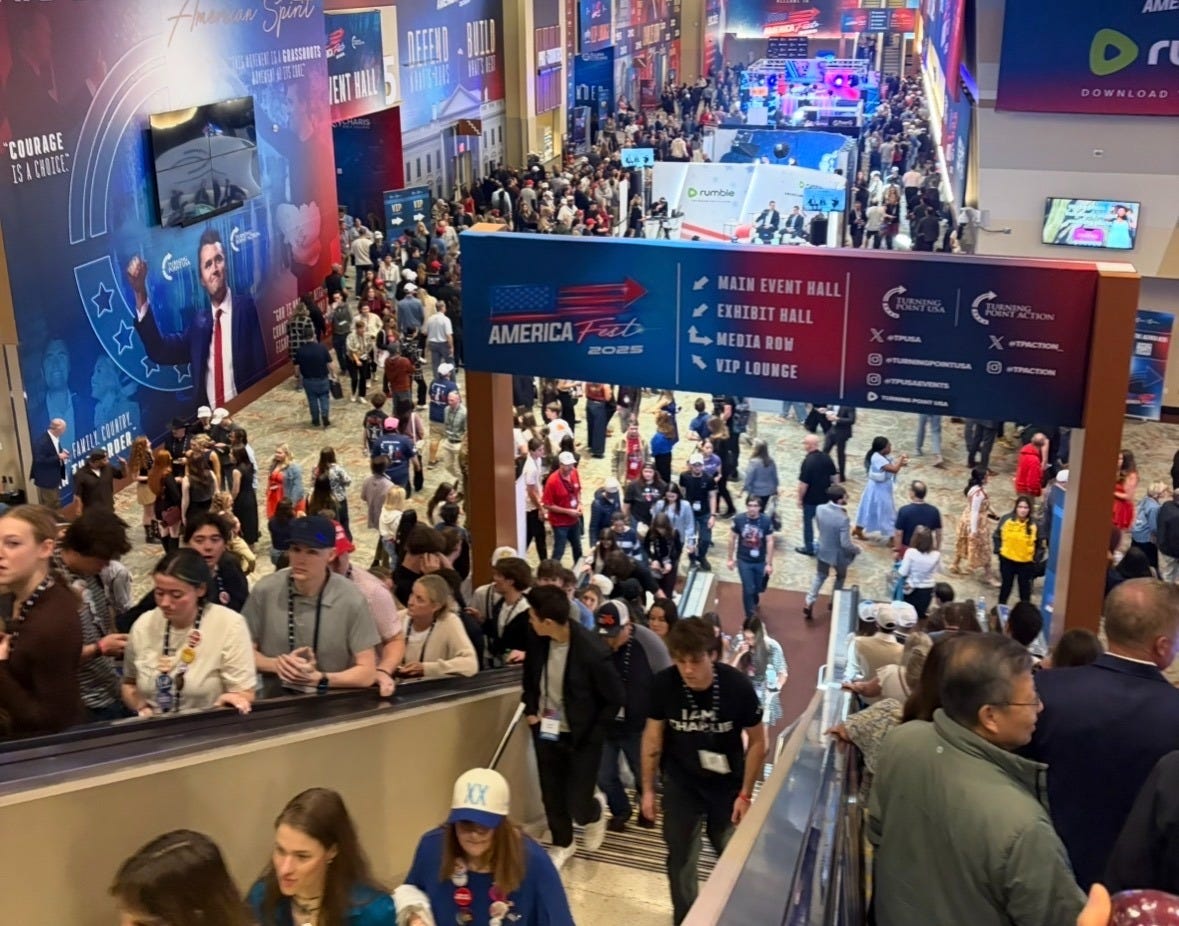
Once I escaped media row - filled with micro-celebrities being trailed around by fans like it was some kind of conservative cosplay convention - I passed endless booths of laughing men in blue suits recycling the same twenty right-wing talking points they’d been repeating since roughly 2015.
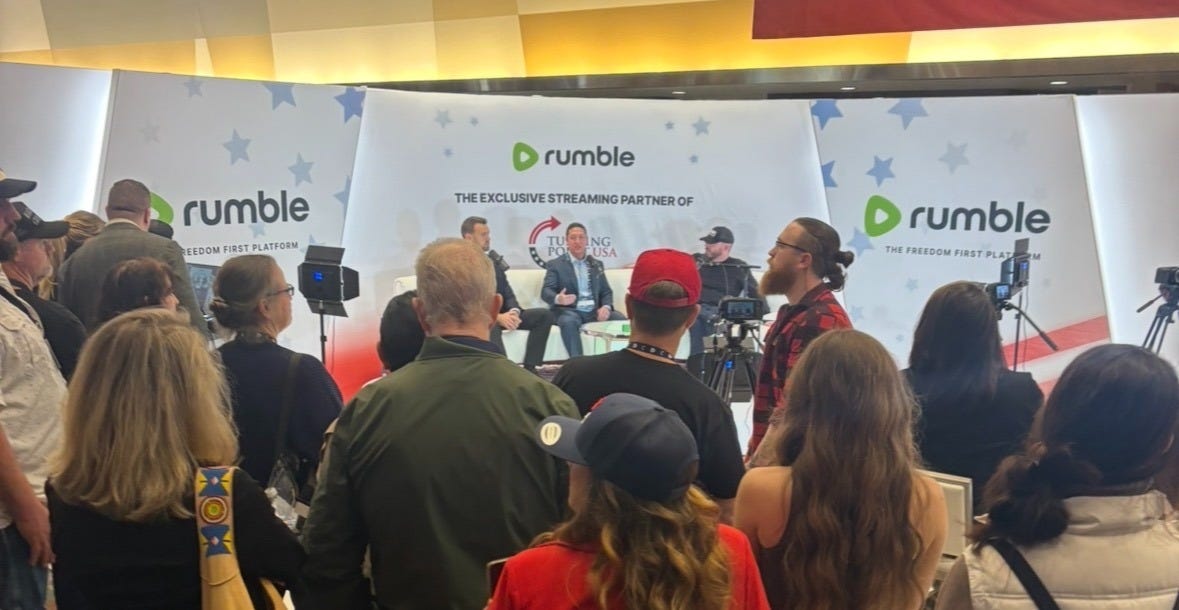
Then I entered the vendor hall.
Which was somehow worse.
There was a flashing neon sign that indicated some kind of: “PRAYER BOOTH.”
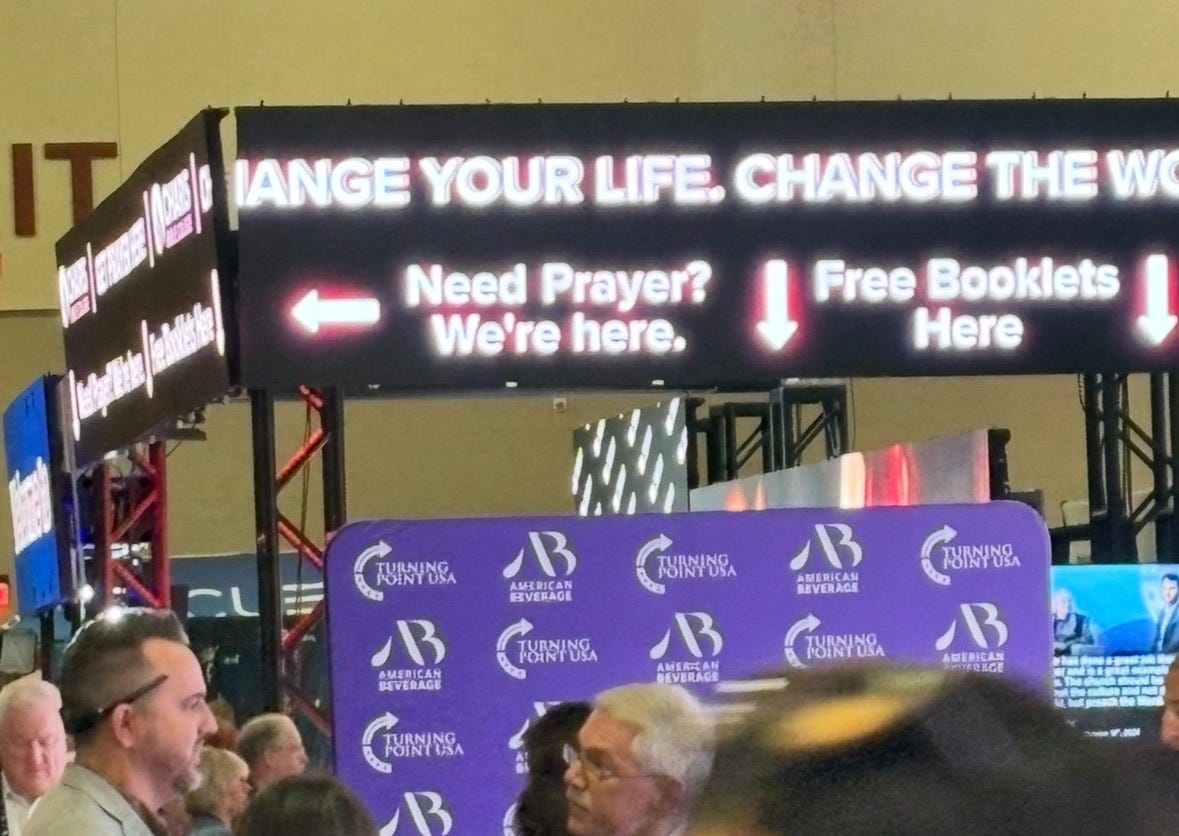
Beside it: hot tubs, massage chairs, and endless “CALL 1-800-555-BLAHBLAH” boomer-bait products being aggressively marketed to retirees in quarter-zips.
And worst of all, there was a replica of the tent Charlie Kirk had been shot under, repurposed as a photo-op for influencers to take selfies in front of.
Directly across from a woman selling $500 sequined Charlie Kirk jackets.
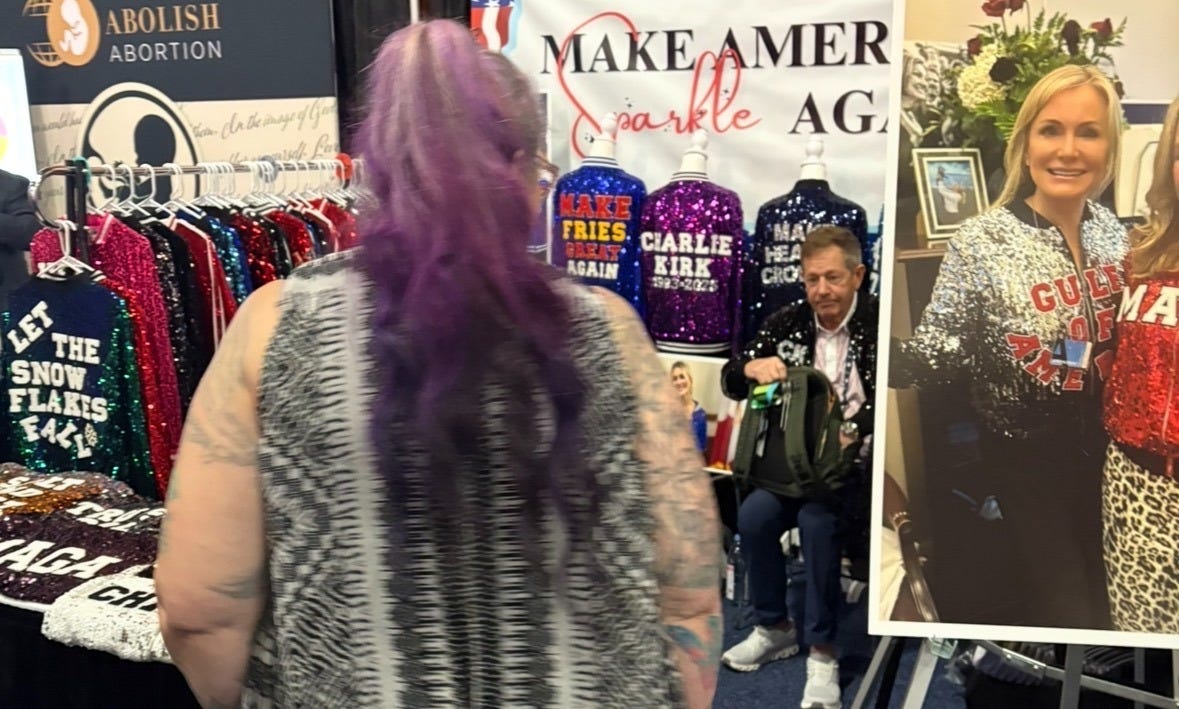
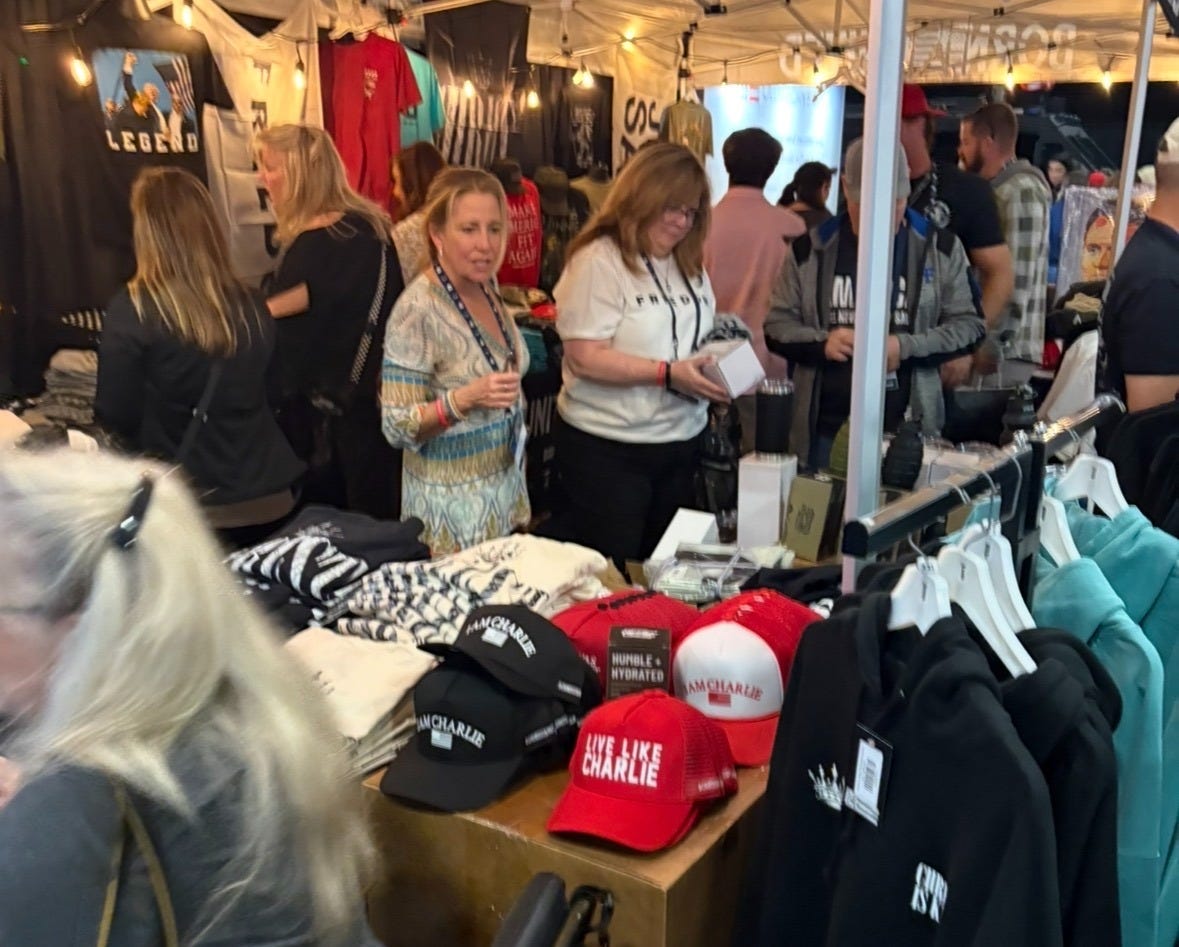
Now, I’m not above enjoying nice hotels or expensive shoes or makeup or vanity. But there are levels of materialism, especially when fused with politics and spirituality, that should make any healthy culture feel physically ill.
It became difficult to see the convention as anything other than a grotesque parody of both the man who died and the broader state of American politics.
And to be fair, I’m not indicting every individual involved. There were genuinely good people there doing meaningful work. But anyone with two functioning brain cells could still recognize the broader spectacle for what it was:
A circus.
And speaking of circuses, and my unfortunate tendency toward personal distractions, of course there had to be a few familiar acts.
Time practically slowed to a crawl when I spotted The Quartering (Jeremy Hambly) tucked into a tiny blue booth in the far back corner of the vendor hall, livestreaming with a few women I vaguely recognized from the internet, including one of Tim Pool’s rotating co-hosts.
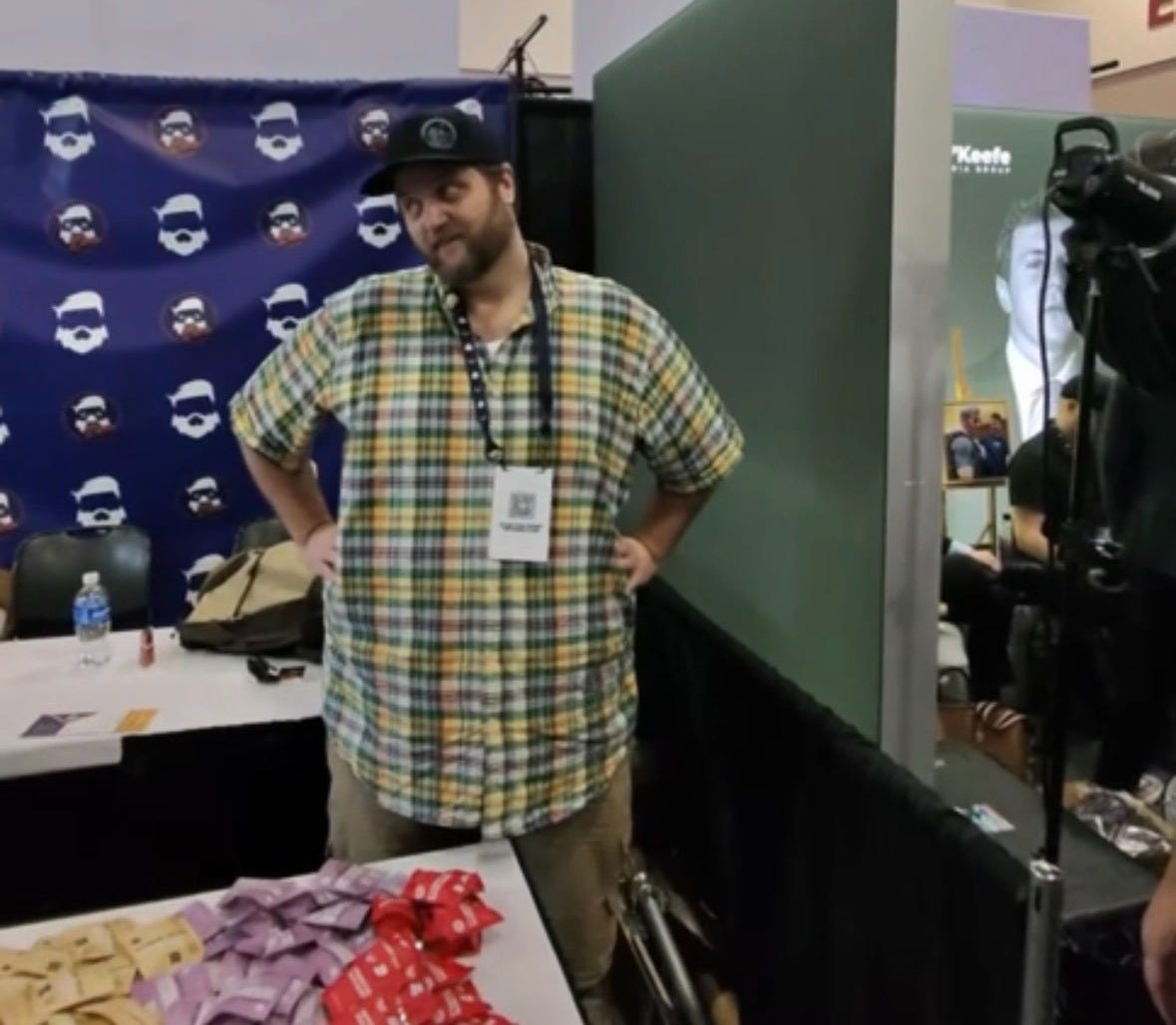
And watching them, I was suddenly struck by how bizarre the entire ecosystem had become.
Most of these podcast co-hosts exist almost exclusively as human laugh tracks and hype-men for the main personality. I’m genuinely not convinced many of them could survive pushing back in any meaningful way against the low-effort headline-slop content strategy most right-wing podcasts have evolved into.
I’ve done both Jeremy’s and Tim’s shows. No one on these shows does any real preparation before going live. No articles sent beforehand. No research packets. Everyone just sits in a circle trying to improvise entertaining reactions using the roughly one percent knowledge they possess on any given topic, supplemented by frantic Googling on their phones whenever the camera cuts away from them.
You can literally watch everyone performing the same exhausted mental gymnastics between topic changes. Every story gets discussed for about two to five minutes before everyone collectively moves on to the next outrage pellet.
When I was younger, I barely questioned any of this. Of course not. When you’re young, you’re a genius. And when you avoid thinking too hard about anything, you get to remain a genius indefinitely.
But as I got older (and as the consequences of this ecosystem started affecting me personally), it became impossible to ignore how psychologically corrosive this entire content machine really was. And yes, obviously I’m selfish too. Most people only fully understand systemic dysfunction once it starts humiliating them specifically.
I wrote extensively about this in my book. But honestly, publishing it only gave me an even clearer front-row seat to the machine in action.
Most of This Is Not Real Life was about social media, ego, corruption, fame, loneliness, manipulation, undercover operatives, love, and the spiritual consequences of living online.
But naturally, the internet focused almost exclusively on anything involving sex.
Particularly the section discussing Andrew Tate’s assault on me.
I’m not going to relitigate the entire thing again because I’ve already written enough Substacks about it to qualify for psychological warfare compensation.
The point is: the clickbait ecosystem, especially figures like Tim and Jeremy, immediately latched onto the story because they knew it could generate engagement.
And what made it worse was how obvious it became that neither of them had actually read the material they were discussing. Now, it’s one thing to say: “Here’s what people online are claiming, I haven’t reviewed everything yet, we’ll wait for more information.”
That would at least be intellectually honest.
Instead, both of them simply went on air and declared: “She’s lying.”
No evidence presented to their audience. I never got a phone call, text or email for a statement. No invitation to respond. Nothing. Despite both of them having known me personally for years. Tim for over a decade.
But I think they understood something very important:
Accuracy doesn’t matter in this ecosystem.
They haven’t cultivated audiences that consume longform nuance or thoughtful analysis. They’ve cultivated audiences trained to absorb prepackaged opinions about headlines like babies being airplane-fed orange paste.
And there is perhaps no more profitable internet headline than:
“Dumb bitch lies about rape.”
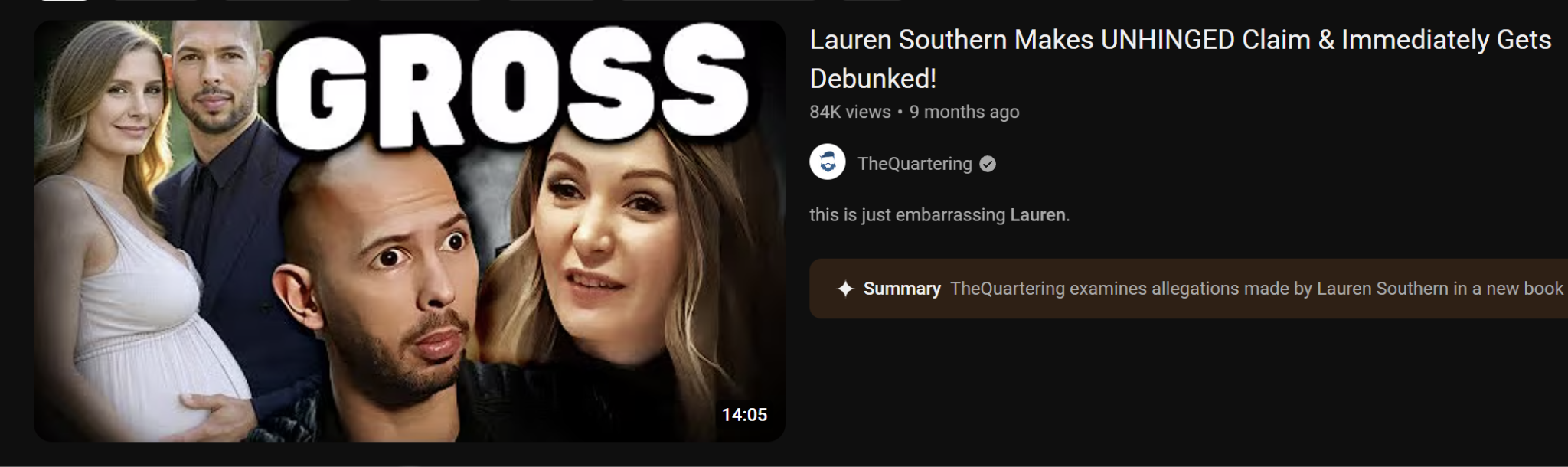
The most revealing part is that they didn’t even bother getting the basic facts right.
Jeremy outright claimed - first on X, before deleting the posts - that I never went to the police, had zero evidence, and fabricated everything for money. Every single one of those claims was already directly addressed in chapters I released publicly, for free.
He also leaned on Tommy Robinson saying I lied. I responded to Tommy point-by-point and debunked him publicly. Since then, Tommy has done what these people usually do once specifics enter the conversation: ignored the rebuttal and moved on.
Then there’s Tate, whose “response” was essentially just “she’s lying.” Despite repeatedly threatening legal action, he still hasn’t managed to send something as simple as a cease and desist.
Of course Jeremy won’t mention any of that.
Because actually engaging with evidence would interrupt the performance. He skimmed a few sentences that could be clipped into a convenient “Lauren bad” narrative, then spent the rest of the segment whining that I declined his “very generous” job offer.
For the record: it was $200 a week.
And naturally, after all that, he called me a dumb whore.
Par for the course. Though I do wish my critics would occasionally surprise me with a new insult. The material is getting stale.
As I walked past his booth, I could feel myself staring holes through him while he rambled to his livestream audience, confidently wrong about something as usual I’m sure.
And for a brief moment I seriously considered walking directly into frame, pulling up a chair beside him with a giant grin on my face, and making him explain the details of a case he had confidently monetized without apparently spending even four consecutive minutes researching.
I grumbled and thought better of it. I wasn’t trying to turn myself into a spectacle again. I’m trying to become more mature now. Allegedly. Part of maturity, unfortunately, seems to involve suppressing one’s natural instinct for bloodsports.
So instead I wandered back across the street to the hotel where I was staying with my friend Caroline and spent the next hour getting ready for a party that evening, mentally chewing on the question of where exactly the line exists between defending yourself and getting permanently trapped inside the outrage machine.
Is it actually healthy to let people lie about you to massive audiences without consequence?
Or does trying to correct every lie just condemn you to endless public mud wrestling? Are people like TheQuartering - endless online gossiping, rage-farming, confidently lying into microphones for profit - simply an unavoidable feature of the internet now? And if you fight back, do you just end up dragged into the same swamp? You know the saying: never wrestle pigs. They enjoy it and you just get filthy.
I’ve never really figured out where the correct balance lies.
That night I went to James O’Keefe’s party and immediately found myself surrounded by a million faces I recognized from internet-land. Self-appointed groyper generals. Trad larp accounts made flesh. Conspiracy schizoids. Influencers I’d known since the 2015–2016 era of political internet insanity.
Every interaction was positive. Or at least positive on the surface.
And to be fair, there were absolutely people there I genuinely liked.
But unfortunately I have an extremely good memory when it comes to the internet.
I’d missed a lot during my hiatus, but during the peak of my cancellation in late 2024 I was still terminally online enough to remember exactly what many people had said about me.
There were only a handful of these types who actively said hello, and as they smiled and reached out to shake my hand - “Lauren! Huge fan of your work. We should catch up sometime. Want to take a photo?” - I could practically see their old tweets floating above their heads like subtitles.
“Dumb slut was never really right-wing.”
“HAHAHAHA get fucked.”
“Hope she never comes back.”
And then I’d smile warmly and shake their hand back.
Ew.
Part of me felt I couldn’t really judge them as cowards when I was also choosing not to say anything back. But the larger part of me simply could not be bothered. I kept wandering away from the crowds throughout the night just to observe things from a distance.
At one point I sat at the bar with an old fan of my work who told me he used to watch my videos in high school. I laughed at how ancient that suddenly made me feel, and then we both watched as a woman in lingerie performed burlesque inside a giant martini glass for a roaring conservative audience.

Despite how absurd the whole scene was, in some ways it felt more honest than the actual conference. I don’t recall James O’Keefe ever pretending to be some steward of traditionalism anyway.
Eventually Caroline and I wandered back to the hotel and stayed awake talking until we both passed out.
The next day was more of the same. A few interviews. Lunch with friends. More wandering and observing. That evening I was heading to grab dinner when I glanced into a crowded restaurant and spotted a few familiar faces sitting together in the corner.
And there he was.
Jeremy. The Quartering.
Sitting with members of his team alongside a few old friends I recognized from TimCast.
The part of me wondering whether I was about to make a spectacle of myself suddenly died.
There weren’t even cameras rolling.
Could it really be that bad?
The mischievous little imp living inside me - the one that has, over the years, contributed to me being banned from multiple countries - slowly began curling the corners of my mouth upward as I made a beeline for his table.
I grabbed a chair from a nearby high-top, dragged it across the floor, and slid directly across from Jeremy with a grin.
“Well, look who it is.”
Jeremy looked like he’d just seen a ghost. He physically tried looking away from me.
“So,” I said, still smiling, “why’d you make that video about me?”
“What video?”
“You know. The one where you AI-edited me pregnant with Andrew Tate’s child.”
“Oh.” He shrugged awkwardly. “That’s just the business. You get it.”
“No, not really. I actually don’t. Why did you lie and tell your audience I never went to the hospital or the police?”
“Well…” he stammered, “I don’t really know the case that well. It’s incomplete.”
I blinked at him.
“Then why did you make a video about it?”
The table had gone almost completely silent at this point.
“I did go to the police. I did go to the hospital. And I’m literally testifying in multiple cases.”
“Oh. Really?” he muttered. “I didn’t know that. Well… it wasn’t really about that anyways. I heard you were talking shit about me in some group chat.”
I actually laughed.
“...Wait. You made a video lying about a human trafficking case, called me a whore, and edited me pregnant because you heard I said something mean about you in a group chat?”
“Yeah,” he said defensively. “I don’t like being betrayed.”
“Show me the message.”
At this point the entire table was frozen in awkward silence while I leaned forward pressing him for answers. Jeremy sat fumbling with his phone while his co-host Melanie Mac stared at him from the side with the expression of someone watching a slow-motion car accident.
He scrolled for what felt like several full minutes before finally sighing.
“I dunno. I can’t find it. Anyways, when the case is done I’ll make an apology video, okay?”
“Yeah, sure buddy,” I said. “We’ll see if that ever happens.”
“I will,” he insisted. “I mean it.”
I didn’t believe him then and I definitely don’t believe him now.
As of last week, the case has already been pushed back another year due to police opening a new investigation involving additional evidence. That’s how these things always go. The people who farmed the initial outrage never have to meaningfully correct themselves because there’s always another excuse to delay accountability indefinitely.
The clicks already happened.
That’s the only part that really mattered.
I left the table and wandered back toward the hotel feeling admittedly pretty smug about the interaction. There’s something deeply satisfying about watching a man who confidently broadcasts opinions to hundreds of thousands of people immediately collapse into awkward mumbling the second he’s confronted in real life.
But even then, none of it actually felt like justice.
Nobody at the table stood up and said, “Wow, that’s actually a horrific thing to do to someone.”
Nobody walked away from working with him. Nobody corrected the record. The video stayed up.
And honestly, I understand why.
Because everyone in these systems, including me, always has an infinite supply of explanations for their own behavior.
I need my career.
I need access to powerful people.
They’re misunderstood.
They’re trying their best.
Human beings have endless moral outrage for the sins of strangers and endless extenuating circumstances for their own.
I don’t fully understand the current Quartering drama.
I’m no longer terminally online enough to follow every livestream, Discord leak, and four-hour YouTube rant, so I only know fragments from clips, posts, and articles I’ve stumbled across.
From what I can gather, he’s currently facing backlash after feuding with channels like Kino Casino.
The central controversy seems to be that Kino Casino heavily mocked and criticized him, after which Jeremy allegedly began threatening to go “scorched earth” while attempting to report, flag, or demonetize their channels.
Which, naturally, many people found deeply ironic.
Because criticizing, mocking, targeting, and publicly humiliating other internet personalities has quite literally been the business model Jeremy built his career around for years.
What’s strange for me though is that I know almost all the characters involved in these endless online wars, at least tangentially, in real life. And honestly, I care far more about how people behave offline than whatever narrative is unfolding online that week.
Kino Casino was founded in part by Andy Warski. We haven’t hung out properly in a long while, but when we were younger we used to go out in Toronto to grab brunch or hit the town. I vividly remember EDM clubbing with Andy and his girlfriend during the peak of his bloodsports era, a genre he largely founded in the early online days.
I also recently learned from Ian Miles Cheong that apparently Andy and I had a sexual relationship. News to me. Though to Andy’s credit - and unlike many men online who happily let that kind of rumor circulate indefinitely - he immediately tweeted at Ian asking what the hell he was talking about.
Which honestly made me laugh.
Anyways, the whole thing feels surreal sometimes. I have all these bizarre interpersonal connections to people constantly waging nuclear internet wars against one another over livestream clips and audience capture and online territory.
And then you see them in real life and they’re just… people.
People you’ve eaten tacos with at 2 a.m, who you’ve wandered around Manhattan bars with or watched cry over relationships, stress over work dramas or celebrate wins.
It genuinely feels at times like I accidentally grew up alongside an entire generation of internet personalities who all became progressively more psychologically damaged in public together.
And then there’s Jeremy and his circle.
I’m sure they’ve got stories like this too. Hanging out together in real life. Going to bars. Meeting girlfriends. Helping each other move apartments. Existing as actual people away from livestreams and analytics dashboards.
Because offline is kind of the entire point of all this.
That’s the weird truth underneath all of internet culture. Most creators don’t actually want “online influence.” They want the real-life influence that comes from online influence.
Most internet creators were nerds growing up. Losers even. Awkward. Lonely. Weird. Socially anxious. Mildly autistic. Overweight. Obsessed with escapism and identity construction. And before anyone gets offended, relax, a lot of those things applied to me too.
The internet just gives people the opportunity to edit themselves into someone they wish they already were.
And once people build an identity around that version of themselves, they cling to it like it’s oxygen. Because deep down I think a lot of creators are terrified that if the views disappear, or the money disappears, or the audience leaves, they’ll be forced to sit alone with themselves again. Which, quite frankly, is a terrifying experience. I just did it myself the last year and it was fucking awful.
What’s one to do without an algorithmically generated sense of purpose? Without a constant feedback loop telling you who you are?
No little stream of dopamine notifications reassuring you that you exist and people care.
Without it, you find out very quickly that a shocking number of your friendships only last as long as the money, relevance, and status do.
Which is why Jeremy is now publicly lamenting being “thrown under the bus” by old colleagues and internet allies. But were these people ever really deep friends? Or were they mostly business partners? The friendships being all part of the digital play?
Because once someone starts spiraling publicly, mass flagging channels, threatening “scorched earth,” deleting things, crashing out every few hours online… you really stop being a very appealing business associate.
Most people in these spaces are not surrounded by genuine friends. They’re surrounded by employees. Orbiters. Co-hosts. Networking connections. People whose careers are tied together like a weird little human centipede of audience overlap.
The people who actually stay in your life during a real crisis are usually the people willing to tell you you’re acting like a complete idiot. Not your employees, other podcast hosts, or people financially tied to your reputation.
Real friends can smack you upside the head and still love you afterward.
Now, I’ve seen Melonie Mac (Jeremy’s co-host) defending him through all this current controversy, and honestly maybe they really are genuinely close in real life. I can’t say. I only know the broader patterns I’ve seen after spending way too much of my life trapped in online culture.
I saw Melonie posting about how disgusting internet drama cycles are and how creators manipulate audiences into emotionally investing in endless bloodsports while farming outrage clicks off them.
And honestly?
I agree with her.
But I also had the thought that maybe the call is coming from inside the house?
Anyone who has had a public profile needs to be aware of how easy it is to get trapped in an endless dopamine loop of approval-seeking and ego protection. A loop where eventually anything threatening your public image starts feeling like an existential threat.
Which is how someone arrives at:
“It’s okay to lie about a trafficking case because I heard Lauren said something mean about me in a group chat.”
Or
“It’s okay to try to destroy someone’s income because they criticized me online.”
The self-justification just escalates infinitely because addiction escalates infinitely.
And honestly, I understand Melonie’s instinct to defend Jeremy. There’s even something admirable about loyalty sometimes, even when it’s misplaced.
There are people in my life you will simply never see me publicly attack online because the relationship matters more to me than internet points.
I think the problem starts when someone else weaponizes the machine first though.
I dealt with this after my marriage ended. My ex emailed podcasters and creators a false version of events and I spent years mostly staying quiet because I had absolutely no interest in dragging my private life online. But eventually the story just kept growing and mutating and spreading until I finally addressed it publicly.
And by then it almost didn’t matter.
The original accusation always spreads farther than the correction.
Which is why creators slowly spiral into this paranoid state of pre-emptive self-defense where they stop reacting to attacks and start reacting to the possibility of attacks.
You can literally see it in Jeremy’s explanation for why he made defamatory content about me.
He “heard I said something mean in a group chat.”
That’s how fragile internet identity becomes eventually. The reputation becomes everything. These creators are beyond truth, fairness or proportionality. They just care about protecting the avatar at all costs.
And I get the temptation because I’ve watched my own public reputation collapse multiple times now and honestly it does feel like a kind of psychological death. I also do know a variety of paths I could’ve taken to “save it” - and I sometimes envy creators who defend themselves in ways that I simply never did.
But eventually, part of you has to let it die.
Because if you spend your entire life trying to crush criticism, silence people, control every narrative, punish dissent, and protect your ego at all costs, eventually you start behaving like you think you’re God.
And no human being survives that mindset for very long.
Eventually reality humiliates everybody.
Which is why when I watch these endless online rampages now - the smears, the betrayals, the ego spirals, the attempts to destroy people - I mostly just feel strangely calm about it all.
Because maybe it takes months. Maybe years. Maybe an entire decade.
But eventually God always gets the last laugh.
The internet is full of people performing omniscience for an audience while privately unraveling under the weight of their own ego. It’s a stage where everyone demands worship and eventually receives humiliation instead.
And honestly, there’s something comforting about that.
Because the sheer inevitability with which people collapse under the fantasy of their own godhood is one of the strongest arguments I’ve ever seen that human beings were never meant to occupy that role in the first place.
There's an interesting psychological theory which says that human psychology is influenced by three things, two of which are "imaginary" and "real" (the third one is called the "symbolic" but I'm not gonna overcomplicate things here). To understand how these influence each other, imagine a 3-5 year old female child looking into a mirror and recognising herself reflected back at her for the first time. This would be a traumatic experience for she will also recognise for the first time that all those loving and reassuring comments from parents and friends like "oh, you are such a good girl!", "oh, aren't you a little beautiful princess!" and all that were not really directed at the "real" her but at her "imaginary" reflection of the "real" her. Self-doubt, acknowledgement of imperfection, and fragmented and suppressed emotions, and more - all that "real" her coming up against the outside image of her that does not quite fit what she knows herself to be. Only "ego" (including "god complex" you mentioned) can bridge that gap but it's all too fragile. The distance between the "imaginary" and the "real" her can never be bridged - not especially after going through such a traumatic "mirror stage" in her childhood development. Teenage rebellion follows (how often do we hear teenagers say, "but, mom, you are not understanding me!" and such like...), but the trauma haunts even her adulthood if it were not for a supportive social circle of friends and family reassuring her that she's enough for who she really is. But not everyone is lucky enough to have such a loving social circle as they grow up. For some, such trauma is carried into their internet persona and their rage onto a virtual crowd who, in the end, does not care a jot about their inner struggles and, worse still, cannot replace a loving social circle of friends and families they so desperately craved in their childhood. So sad. :(
The world of online politics relies heavily on inflammatory headlines for profit.
The issue is there is so much competition for attention that only the most primal language succeeds in garnering investment.
Additionally, many wrap their identity in specific labels that help them understand their world easier. Adding layers of complication requires too much cognitive processing for most people.
People want heuristics that are successful in getting them what they want more often than not.